
Months have passed since my last post, and while I’ve had many subjects I’ve wanted to write about, distractions have thwarted my return to the blogosphere. One of my preoccupations has been sorting through boxes of family documents and photos that my sister and I pulled from my parents’ home nearly a decade ago. For years, I’ve wanted to produce a sort of ancestral memoir for my descendants — a text that would describe the lives, or rather what I believe to be true about the lives, of my forebears.
The project is challenging because, ideally, I’d like to weave together historical context, my personal experience with the ancestors I actually knew, and my and my parents’ opinions about them. If I ever finish, I suspect I’ll consider it a work of fiction, but one that is closely tied to reality. The internet and AI have been useful tools for helping me understand the major events and living conditions that shaped my ancestors’ lives. Such tools have also exposed myriad threads to try to unravel. Thanks to WikiTree, I now know my Kevin Bacon score to Louis XIV.
There have been moments when I wanted to rush to my blog and share my discoveries. Especially when they were related to France. For example, one of my most striking findings was a series of 11 letters my maternal grandfather wrote to his family while he was stationed in Saint-Nazaire, France, at the end of World War I. Those few short missives told me so much about the silent, rather brooding man who was the most likely of my four doting grandparents to scold.

Ties to Detroit’s Earliest Residents
Another francophile revelation sprang from my search to determine the depth of my French-Canadian roots. I spent many hours confirming each link in the ancestral chain that ties me to Jacques Campau (also spelled Campeau), one of the original European settlers of Detroit, the city in which I was born. In 1701, the famous French explorer Antoine de la Mothe Cadillac established Fort Pontchartrain, the remote outpost that became Detroit, and 8th-great-grandpa Jacques first set foot there in 1703.
In case you weren’t aware, the French word détroit means “strait” in English. In the early 1700s, French fur traders dominated the commerce along what is now the Detroit River, a waterway linking the Great Lakes surrounding Michigan to Lake Erie and ultimately the Atlantic Ocean. When English traders began appearing in the area, the French wanted to keep an eye on their activities. So, they established Fort Pontchartrain du Détroit along this narrow strait to better control British vessels attempting to pass through. Who would have guessed that commandeering a narrow waterway, through which vital exports flow, might prove advantageous?
After several voyages between Detroit and Montreal, Jacques returned to Fort Pontchartrain in 1708 with his wife, Jeanne Cécile, and three of their children. At the time, the French population fluctuated between 100 and 200 residents. The family of five would have made the journey in 35- to 40-foot-long canoes, relying on French-Canadian voyageurs and Indigenous paddlers to safeguard their passage.

When Records Mislead
When I come across information like this, a dozen more questions come to mind, and I can quickly detour off my intended path only to find myself lost in the weeds three hours later with another dozen unanswered questions hastily scribbled in a notebook. Tangling my puzzling pathway are the published records of people who did sloppy research, leaving me to figure out where the truth lies, or at least where the closest to the truth lies. Adding to the challenge is the fact that some of the best primary sources were scrawled more than 300 years ago by Catholic priests or government scribes writing in archaic French.
One newspaper article from the Windsor Star, printed in 1933, stated that Jacques had been one of Cadillac’s closest friends, as well as his personal secretary. Several aspects of this claim, which popped up in more than one place, didn’t ring true to me. After some digging, I discovered the claim’s aura of legitimacy likely originated with Marie Caroline Watson Hamlin, a local historian who wrote Legends of Le Détroit in 1884. Her chapter on the Campaus relied on interviews with descendants, who had slowly elevated Jacques’ position over more than a century. To be fair to Hamlin, she did use the word Legends in her title. Hence doth myth turn to reality in the minds of the hurried.
Using Gemini and Google to locate better historical sources, I discovered a more plausible depiction of Jacques Campau. In those pivotal early years, Cadillac was intent on transforming Detroit from a military outpost into a money-making ecosystem. To incentivize colonizers, Louis XIV endowed him with the power to award land grants to promising settlers. Very generous of him, right? Not exactly. In 1708, the banks of what is now the Detroit River were hardly deserted, instead resembling a bustling commercial center supporting four different Indigenous peoples, intensely engaged in trade with each other and the French soldiers they outnumbered by 5 to 1.
A skilled blacksmith, Jacques was a valuable addition to the community, perhaps especially vital for safeguarding the supply of armaments needed to secure the fort when tensions flared between trading partners. He also possessed a rare skill that would have been highly prized. He could read, write, and keep books. While I could find no record of a Jacques Campau or Campeau working for Cadillac in any official capacity, it’s likely that Cadillac occasionally called on him to help with official correspondence or record-keeping.
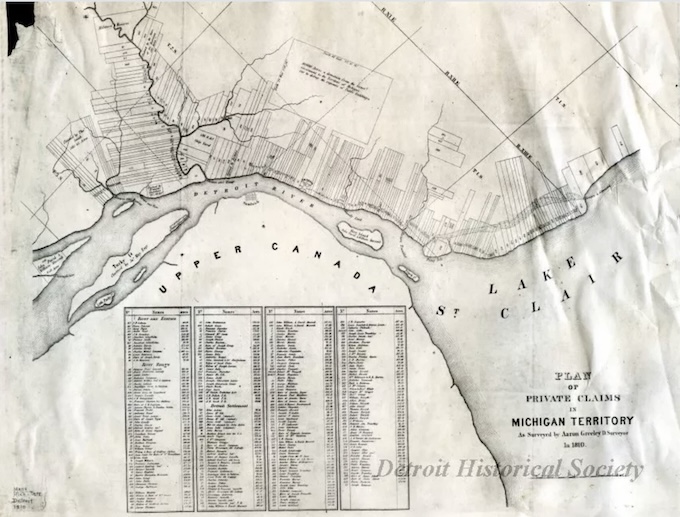
In any case, Jacques was handsomely rewarded with a parcel of land inside the protective walls of Fort Pontchartrain where he set up his home and forge. He also received a sizable ribbon of land to farm. This latter property had between 600 and 750 feet of waterfront along the Detroit River and was roughly 1.5 miles deep. I find discoveries like this to be double-edged. On one hand, I’m proud of my ancestors’ grit, aptitude, and courage. On the other hand, I’m dismayed by their sense of entitlement and their belief that the people who had lived all over North America for centuries had no rights or claim to land.
Populating a Continent: Les Filles du Roi
When searching for a particular person online, you’re likely to encounter many different people with the same or similar name. It’s also easy to find many different spellings of the same first and/or last name that all refer to the same person. This particular Jacques Campau/Campeau, my 8th-great-grandfather, who was one of the first European residents of Detroit, was born in Montreal in 1677. When and where, I wondered, were his parents born? Ancestry and WikiTree both led me to the same progenitors: Étienne Campeau dit Limousin, born in Brive-la-Gaillarde, France, about 1638; and Catherine Marie Paulo, Fille du Roi, born in La Rochelle, France, about 1646.
There lay the last link I’d been seeking, connecting my genes to French soil! I was thrilled, but also captivated by this 9th-great-grandmother’s title. She was a Fille du Roi? Literally, a king’s daughter. Google quickly snuffed out any hope I might have held about imperial blood running through my veins.
In 1663, Louis XIV bumped the official standing of New France to that of a royal province, i.e., an official part of France. However, if you’re going to claim a vast uncharted region on the other side of an ocean—where people already live and where many other countries are trying to establish a foothold—as your own, you need citizens to hold it.
At the time, fewer than 3,000 people of French origin lived along the Saint Lawrence River, whereas the British colonies had grown to roughly 80,000 settlers. In addition, within the French population the ratio of unmarried men to unmarried women was 7 to 1. Louis needed women who would breed like rabbits, and he needed them ASAP. Thus was created Les Filles du Roi, a prestigious selection of young ladies vetted for good health and upstanding character. To be considered for the post, each candidate had to produce a “certificate of good conduct” signed by a priest or judge from their hometown.
Over the next ten years, the French king sent roughly 800 women to the New World in the hope they would go forth and propagate. One perk, which probably made the deal more attractive, was that these women could choose their husbands upon arrival, not the other way around. Before boarding the ship that would permanently separate them from their loved ones, each woman received a trousseau—a large trunk stocked with clothes, sewing notions, cutlery, and other domestic necessities. Once wed, the king would kick in an extra 50 to 200 livres, depending on the social standing of her husband. This was the equivalent of 3 to 12 months’ earnings.
It probably seemed like a sweetheart deal until you found yourself, four weeks out, no land in sight, still wearing the clothes you departed in, hoisting your skirts and swaying precariously over the guardrails for the umpteenth time as you purged several days’ worth of dried meat and hardtack into the sea. But I digress. Luckily, meticulous records were kept on these women, and sure enough, I found 9th-great-grandmother Catherine Paulo’s name among the 36 bachelorettes aboard the very first shipment of Filles du Roi, which took 111 days to cross the Atlantic.

I haven’t learned much about her husband, Étienne, but rumor has it that he was the son of a count. TBD. Regardless of her husband’s prominence, Catherine proved to be a dutiful executor of the king’s vision, managing to kick out 15 children and dying at the age of 70. I did some back-of-the-napkin calculations and estimated that if, over the generations, each of her descendants averaged three children of their own (a number that seems conservative given the Catholic propensity for childbearing), roughly 2.5 million people could now refer to her as their 9th-great-grandmother. However, the number of Catherine’s living descendants is probably much greater than this. According to FamousKin.com, one of her 8th-great-granddaughters is Hillary Rodham Clinton.
Enlisting AI
I must admit to using AI agents to help track down reliable sources. One such source is a wiki of Quebec church records going back to 1621. This site had me whooping hallelujah after two days of trying to determine whether a woman I believed to be a maternal great-great-grandmother had gone by two relatively different names: Delima (at times listed as Delina or Delia) Joinet and Aurelie Joanette. Census records showed both women were born in Quebec on the same day. It didn’t help that the husbands for these two were also inconsistent, with multiple versions of the first name and several spellings of the last name. Try as I might, I couldn’t prove that Delima Joinet was also Aurelie Joanette until Claude sent me to this site, where I found a birth record for Delima Aurelie Joanet.
Gemini has also been helpful. It has led me to many fascinating articles, and I wish I had the bandwidth to digest and consolidate the relevant pieces from all of them into a captivating and coherent narrative. Of course, Gemini seems eager to do that for me, but I refuse to render my involvement in this endeavor next to useless. Anyway, one such article was written by Suzanne Boivin Sommerville, a translator who talked about the difficulties of transcribing the archaic French that Catholic priests used in the 18th century. I was interested in what she might say that could help me decipher the scrawl in handwritten registers. Instead, I came across a delightful passage relating to 8th-great-grandparents Jacques and Jeanne Cécile.
Sommerville complained about a faulty footnote resulting from a poor translation of Jesuit records. The annotation stated that Jacques and Jeanne Cécile’s son Nicolas Campeau was nicknamed Niagara after being dropped in the water near the Niagara portage between Detroit and Montreal. She explained that the problem was rooted in a misinterpretation of the French verb ondoyer. Sommerville suspected that the verb baffled the original translator, who chose to write that the baby was dropped in the water. She explained, “If a priest cannot be present to administer the sacrament, anyone can baptize.” In 1710, on a return trip to Montreal, perhaps to visit family, Jeanne Cécile likely gave birth to Nicolas. Fearing the newborn might die before reaching a priest, someone in their party, perhaps Jacques, performed an ondoyement, sprinkling the child with ordinary water while pronouncing the sanctifying lines of scripture that would save Nicolas from Satan’s grasp.
This unexpected anecdote was far more gripping than the pitfalls of working with archaic French.
An Infinity of Loose Ends
Some of my research is exciting for me, but has nothing to do with France or French culture. My father’s side of the family is Dutch and German. Here, too, I can find deep roots that predate the founding of the United States. My oldest American-birthed ancestor was born in 1627 in New Netherland, a colonial province spanning parts of modern-day New York, New Jersey, Delaware, and Connecticut. Certain family documents claim (WikiTree and Google support this) that she was the second person of Dutch descent born in the Americas. Her older sister was the first.
While I’ve barely skimmed the surface of a handful of genealogical branches, I have a growing sense of the extraordinary advantages my ancestors (and I) have enjoyed simply because they were early immigrants to a continent ripe for exploitation. After the Revolutionary War, over 6.5 million acres were set aside in what would become the state of Ohio to use as compensation for veterans of the Continental Army. Some of that land, however, was also granted to George Washington’s supporters and cabinet members. Many of them, in turn, quickly unloaded these fertile terrains to East Coast speculators who made handsome profits selling large tracts to ambitious pioneers. Again, it appears a different chain of my ancestors benefited from land theft and displacement of Native peoples.
Last spring I visited a Pioneer Village in Warren County, Ohio, that has preserved the log home my grandmother was born in. The house was built in 1825 on land that passed from the federal government to a wealthy real estate developer through a short chain of early settlers, until my great-grandfather Vandervoort bought it. But that is another story with its own set of details and detours for me to track.

And so ends my nine-month pause from blogging. To those of you who subscribe, it’s good to be back. I’ll try not to wait so long until my next post.
Discover more from cas d'intérêt
Subscribe to get the latest posts sent to your email.


Very glad to see you posting again. I was afraid you were gone for good. I hope the “distraction” issues you mentioned have been resolved.